
Cate_marketing_credit_case_study
📘 Which group is more sensitive to treatment? Conditional Average Treatment Error (CATE) & Treatment Heterogeneity
Demonstration with Marketing & Credit data, including comments
This notebook mirrors the ideas from the chapter 6 of Facure’s Causal analytics book:
- Effect heterogeneity: different units respond differently to the same intervention.
- CATE: treatment effect conditional on context/features.
- Evaluation when you can’t observe individual effects:
- Effect-by-quantile plots
- Cumulative effect curves
- Cumulative gain curves (+ AUC)
- Ordering vs calibration: ranking is often what matters for decisions.
- Target transformation / pseudo-outcomes: an MSE-like comparison tool.
- Decision-making: treat top‑K/top‑p% where benefit is largest.
Because OpenML access can fail (firewall/outage), this notebook has two paths:
Path A — Real public datasets (requires internet)
Loads via sklearn.datasets.fetch_openml:
bank-marketing(marketing)credit-g(credit)
Path B — Automatic fallback (no internet required)
If download fails, it generates a synthetic mixed-type dataset and still runs end‑to‑end, producing all evaluation figures.
Public dataset references
- Bank Marketing (OpenML): https://www.openml.org/search?type=data&status=active&id=1461
- German Credit / credit-g (OpenML): https://www.openml.org/d/31
0) Imports and stable data loading
We use fetch_openml (scikit-learn) for stable public data access + caching.
Heterogeneous Treatment Effects
This notebook follows the conceptual flow of Chapter 6 of Facure exactly.
The chapter introduces a fundamental shift:
Average Treatment Effect → Individual Treatment Effect Structure
Instead of asking: Does treatment work on average?
We ask: How does treatment effect change across individuals?
The main quantity we want to approximate is:
| τ(x) = E[Y(1) − Y(0) | X = x] |
This represents how treatment impact changes with customer characteristics.
1. Why Average Effects Are Not Enough
Even if treatment is beneficial on average, it may:
• Help some customers a lot
• Have zero effect on others
• Even hurt some segments
Chapter message: Causal decision making should focus on who benefits most, not just whether treatment works overall.
2. Potential Outcomes View of Heterogeneity
For each individual:
Y(1) → Outcome if treated
Y(0) → Outcome if untreated
Individual treatment effect: τ_i = Y_i(1) − Y_i(0)
Since we only observe one outcome per person, we must estimate the missing counterfactual using models.
HTE estimation is fundamentally a counterfactual reconstruction problem.
3. Learning Outcome Functions
Instead of trying to learn treatment effect directly, we learn:
μ₁(x) = Expected outcome if treated
μ₀(x) = Expected outcome if untreated
Then:
τ(x) = μ₁(x) − μ₀(x)
This is the central modeling idea in Chapter 6.
4. How We Evaluate Heterogeneous Effects
We cannot observe true individual treatment effect.
So we evaluate usefulness via ranking quality:
If predicted τ(x) is meaningful: Higher predicted τ(x) → Higher observed treatment benefit
This is why we analyze:
• Effect across score buckets
• Effect among top-ranked customers
Code Context — Environment Setup
This prepares tools needed for:
• Data processing
• Modeling
• Visualization
HTE estimation is built using standard machine learning tools applied in a causal framework.
import numpy as np
import pandas as pd
import matplotlib.pyplot as plt

from sklearn.datasets import fetch_openml
from sklearn.model_selection import train_test_split
from sklearn.compose import ColumnTransformer
from sklearn.pipeline import Pipeline
from sklearn.preprocessing import OneHotEncoder, StandardScaler
from sklearn.impute import SimpleImputer
from sklearn.linear_model import LogisticRegression
from sklearn.ensemble import RandomForestClassifier

np.random.seed(42)
plt.rcParams["figure.figsize"] = (9, 5)
Effect Diagnostics
These functions measure whether model scores successfully separate customers by treatment benefit.
Since individual treatment effect is unobserved, we evaluate whether predicted ranking aligns with observed group-level treatment differences.
def effect_binary(df: pd.DataFrame, y: str = "y", t: str = "t") -> float:
    treated = df.loc[df[t] == 1, y]
    control = df.loc[df[t] == 0, y]
    if len(treated) == 0 or len(control) == 0:
        return np.nan
    return treated.mean() - control.mean()


def effect_by_quantile(df: pd.DataFrame, score_col: str, q: int = 10, y: str = "y", t: str = "t") -> pd.DataFrame:
    quant = pd.qcut(df[score_col], q=q, labels=False, duplicates="drop")
    rows = []
    for k in sorted(quant.dropna().unique()):
        g = df.loc[quant == k]
        rows.append({
            "quantile": int(k),
            "n": len(g),
            "score_mean": g[score_col].mean(),
            "effect": effect_binary(g, y=y, t=t)
        })
    return pd.DataFrame(rows).sort_values("score_mean")


def cumulative_effect_curve(df: pd.DataFrame, score_col: str, steps: int = 100, y: str = "y", t: str = "t"):
    df_sorted = df.sort_values(score_col, ascending=False).reset_index(drop=True)
    n = len(df_sorted)
    cutoffs = np.linspace(max(1, n // steps), n, steps).astype(int)
    cutoffs = np.unique(np.clip(cutoffs, 1, n))
    x = 100 * cutoffs / n
    effects = [effect_binary(df_sorted.iloc[:c], y=y, t=t) for c in cutoffs]
    return x, np.array(effects)


def cumulative_gain_curve(df: pd.DataFrame, score_col: str, steps: int = 100, y: str = "y", t: str = "t", normalize: bool = True):
    x, ce = cumulative_effect_curve(df, score_col, steps=steps, y=y, t=t)
    p = x / 100.0
    ate = effect_binary(df, y=y, t=t)
    gain = p * (ce - ate) if normalize else p * ce
    auc = np.trapezoid(gain, p)
    return x, gain, auc, ate


def pseudo_outcome_transformed(y, t, e, clip=1e-3):
    e = np.clip(e, clip, 1 - clip)
    return (t * y / e) - ((1 - t) * y / (1 - e))


def weighted_mse(y_true, y_pred, w):
    return np.average((y_true - y_pred) ** 2, weights=w)
Code Context — Dataset Preparation
HTE methods require:
• Covariates (X)
• Treatment indicator (T)
• Outcome (Y)
HTE estimation works on both experimental and observational data if assumptions hold.
def load_openml_or_fallback(name: str, fallback_n: int = 20000, seed: int = 0):
    rng = np.random.default_rng(seed)
    try:
        data = fetch_openml(name=name, as_frame=True, version=1)
        X = data.data.copy()
        y_raw = data.target.copy()
        return X, y_raw, "openml"
    except Exception as e:
        n = fallback_n
        X = pd.DataFrame({
            "age": rng.integers(18, 80, size=n),
            "income": rng.normal(60000, 20000, size=n).clip(5000, 200000),
            "balance": rng.normal(1500, 1200, size=n).clip(0, 15000),
            "channel": rng.choice(["branch", "web", "mobile", "call"], size=n, p=[0.2, 0.35, 0.35, 0.1]),
            "segment": rng.choice(["A", "B", "C"], size=n, p=[0.3, 0.5, 0.2]),
            "region": rng.choice(["NE", "MW", "S", "W"], size=n),
        })
        logit = (
            -2.0
            + 0.015*(X["age"] - 40)
            + 0.00002*(X["income"] - 60000)
            + 0.0006*(X["balance"] - 1500)
            + (X["channel"].eq("mobile")*0.3).astype(float)
            + (X["segment"].eq("A")*0.2).astype(float)
        )
        p = 1 / (1 + np.exp(-logit))
        y_raw = pd.Series(rng.binomial(1, p), name="y_raw")
        return X, y_raw, f"fallback (OpenML error: {type(e).__name__})"
Constructing a Heterogeneous Treatment World
This step simulates:
• Treatment assignment
• Individual-level treatment heterogeneity
If treatment effect were constant, heterogeneity modeling would collapse to average effect estimation.
def make_preprocessor(X: pd.DataFrame):
    cat_cols = X.select_dtypes(include=["object", "category"]).columns.tolist()
    num_cols = X.select_dtypes(exclude=["object", "category"]).columns.tolist()

    num_pipe = Pipeline([
        ("imputer", SimpleImputer(strategy="median")),
        ("scaler", StandardScaler())
    ])
    cat_pipe = Pipeline([
        ("imputer", SimpleImputer(strategy="most_frequent")),
        ("onehot", OneHotEncoder(handle_unknown="ignore"))
    ])

    return ColumnTransformer([
        ("num", num_pipe, num_cols),
        ("cat", cat_pipe, cat_cols)
    ])

def sigmoid(x):
    return 1 / (1 + np.exp(-x))

def simulate_uplift_problem(X: pd.DataFrame, y_raw_binary: pd.Series, seed: int = 0):
    rng = np.random.default_rng(seed)
    pre = make_preprocessor(X)

    Z = pre.fit_transform(X)
    w_prop = rng.normal(size=Z.shape[1])
    z_prop = (Z @ w_prop).A1 if hasattr(Z, "A1") else (Z @ w_prop)

    # propensity e(x)
    e_true = sigmoid(0.6 * (z_prop / (np.std(z_prop) + 1e-9)))
    t = rng.binomial(1, e_true)

    # estimate e_hat
    prop_model = Pipeline([
        ("pre", pre),
        ("clf", LogisticRegression(max_iter=300))
    ])
    prop_model.fit(X, t)
    e_hat = prop_model.predict_proba(X)[:, 1]

    # heterogeneous effect tau(x)
    w_tau = rng.normal(size=Z.shape[1])
    z_tau = (Z @ w_tau).A1 if hasattr(Z, "A1") else (Z @ w_tau)
    true_tau = 0.7 * sigmoid(z_tau / (np.std(z_tau) + 1e-9))  # [0, 0.7]

    # baseline anchored to label prevalence + feature variation
    p0 = float(np.clip(y_raw_binary.mean(), 1e-4, 1 - 1e-4))
    base_logit = np.log(p0 / (1 - p0))
    base_logit = base_logit + 0.25 * (z_prop / (np.std(z_prop) + 1e-9))

    # observed outcome under treatment
    logit = base_logit + t * true_tau
    y = rng.binomial(1, sigmoid(logit))

    df = X.copy()
    df["y"] = y.astype(int)
    df["t"] = t.astype(int)
    df["e_hat"] = e_hat
    df["true_tau"] = true_tau
    return df
Estimating Counterfactual Outcome Functions
Models are trained to approximate:
Expected outcome if treated
Expected outcome if untreated
Their difference produces an estimate of heterogeneous treatment effect.
Outcome modeling is the core computational strategy for estimating heterogeneous effects.
def outcome_model_score(df: pd.DataFrame):
    X = df.drop(columns=["y", "t", "e_hat", "true_tau"])
    y = df["y"].values
    pre = make_preprocessor(X)
    model = RandomForestClassifier(n_estimators=300, min_samples_leaf=50, random_state=0, n_jobs=-1)
    pipe = Pipeline([("pre", pre), ("model", model)])
    pipe.fit(X, y)
    return pipe.predict_proba(X)[:, 1]

def fit_outcome_model_subset(df_subset: pd.DataFrame):
    X = df_subset.drop(columns=["y", "t", "e_hat", "true_tau"])
    y = df_subset["y"].values
    pre = make_preprocessor(X)
    model = RandomForestClassifier(n_estimators=250, min_samples_leaf=50, random_state=0, n_jobs=-1)
    pipe = Pipeline([("pre", pre), ("model", model)])
    pipe.fit(X, y)
    return pipe

def t_learner_cate_score(df: pd.DataFrame):
    treated = df[df["t"] == 1]
    control = df[df["t"] == 0]
    m1 = fit_outcome_model_subset(treated)
    m0 = fit_outcome_model_subset(control)
    X_all = df.drop(columns=["y", "t", "e_hat", "true_tau"])
    mu1 = m1.predict_proba(X_all)[:, 1]
    mu0 = m0.predict_proba(X_all)[:, 1]
    return mu1 - mu0

def add_scores(df: pd.DataFrame, seed: int = 0):
    rng = np.random.default_rng(seed)
    out = df.copy()
    out["rand_score"] = rng.normal(size=len(out))
    out["y_score"] = outcome_model_score(out)
    out["cate_score"] = t_learner_cate_score(out)
    return out
Visualization of Heterogeneous Effect Quality
Plots evaluate whether predicted heterogeneous effects produce meaningful treatment separation.
HTE usefulness is measured through decision quality, not prediction accuracy alone.
def plot_effect_by_quantile(df, title, q=10):
    plt.figure()
    for s in ["rand_score", "y_score", "cate_score"]:
        tab = effect_by_quantile(df, score_col=s, q=q)
        plt.plot(tab["score_mean"], tab["effect"], marker="o", label=s)
    plt.axhline(effect_binary(df), linestyle="--", color="black", label="ATE")
    plt.xlabel("Mean score in quantile (low → high)")
    plt.ylabel("Estimated effect within quantile")
    plt.title(title)
    plt.legend()
    plt.show()

def plot_cumulative_effect(df, title):
    plt.figure()
    ate = effect_binary(df)
    for s in ["rand_score", "y_score", "cate_score"]:
        x, ce = cumulative_effect_curve(df, s, steps=80)
        plt.plot(x, ce, label=s)
    plt.axhline(ate, linestyle="--", color="black", label="ATE")
    plt.xlabel("Top % of population (ranked by score)")
    plt.ylabel("Effect among top-% subset")
    plt.title(title)
    plt.legend()
    plt.show()

def plot_cumulative_gain(df, title):
    plt.figure()
    aucs = {}
    for s in ["rand_score", "y_score", "cate_score"]:
        x, g, auc, _ = cumulative_gain_curve(df, s, steps=80, normalize=True)
        aucs[s] = auc
        plt.plot(x, g, label=f"{s} (AUC={auc:.4f})")
    plt.axhline(0, linestyle="--", color="black", label="ATE baseline (normalized)")
    plt.xlabel("Top % of population (ranked by score)")
    plt.ylabel("Normalized cumulative gain")
    plt.title(title)
    plt.legend()
    plt.show()
    return aucs
End-to-End HTE Estimation
Pipeline steps: Data → Treatment → Outcome → Counterfactual outcome estimation → Effect ranking
This operationalizes heterogeneous effect estimation in practice.
X_bank, y_bank_raw, bank_source = load_openml_or_fallback("bank-marketing", seed=1)
print("Bank data source:", bank_source)

y_bank_str = y_bank_raw.astype(str).str.lower()
y_bank = y_bank_str.isin(["yes", "1", "true"]).astype(int)

bank_df = simulate_uplift_problem(X_bank, y_bank, seed=11)
bank_scored = add_scores(bank_df, seed=111)

print("Outcome rate:", bank_scored["y"].mean())
print("Treatment rate:", bank_scored["t"].mean())
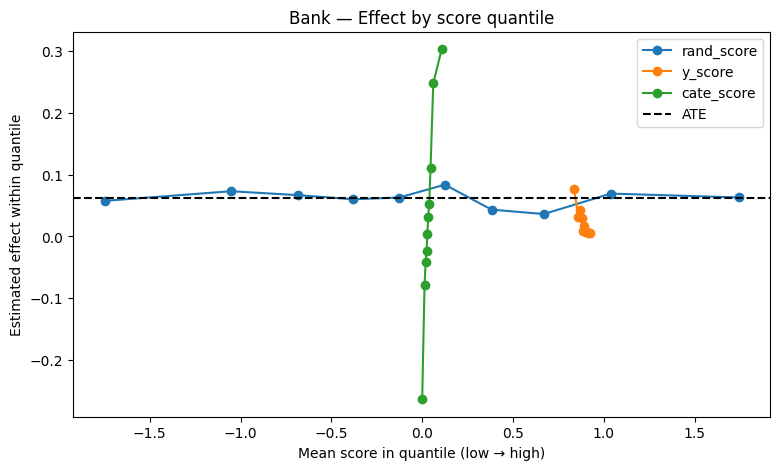
print("ATE:", effect_binary(bank_scored))
Bank data source: openml
Outcome rate: 0.8868638163278848
Treatment rate: 0.4281037800535268
ATE: 0.06168106138306939
Bucketed Effect Visualization
Shows whether customers with higher predicted effect truly exhibit higher observed treatment benefit.
If model captures heterogeneity correctly, treatment effect should increase across predicted effect buckets.
plot_effect_by_quantile(bank_scored, title="Bank — Effect by score quantile")
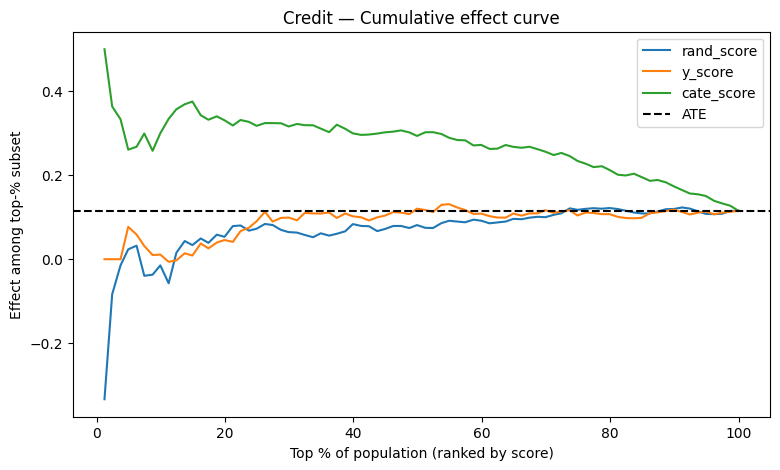
Targeting Curve Interpretation
Shows expected benefit when targeting top predicted effect customers.
HTE modeling is primarily used for treatment allocation decisions.
plot_cumulative_effect(bank_scored, title="Bank — Cumulative effect curve")
bank_aucs = plot_cumulative_gain(bank_scored, title="Bank — Normalized cumulative gain (AUC)")
bank_aucs


{'rand_score': np.float64(-0.0008504006781834974),
 'y_score': np.float64(-0.017501049915101506),
 'cate_score': np.float64(0.047550307185826986)}
Repeating Analysis on New Data
Validates whether heterogeneous effect structure generalizes across datasets.
Heterogeneous effect estimation should not be dataset specific.
X_credit, y_credit_raw, credit_source = load_openml_or_fallback("credit-g", seed=2)
print("Credit data source:", credit_source)

y_credit_str = y_credit_raw.astype(str).str.lower()
y_credit = y_credit_str.isin(["good", "1", "true", "yes"]).astype(int)

credit_df = simulate_uplift_problem(X_credit, y_credit, seed=22)
credit_scored = add_scores(credit_df, seed=222)

print("Outcome rate:", credit_scored["y"].mean())
print("Treatment rate:", credit_scored["t"].mean())
print("ATE:", effect_binary(credit_scored))
Credit data source: openml
Outcome rate: 0.753
Treatment rate: 0.564
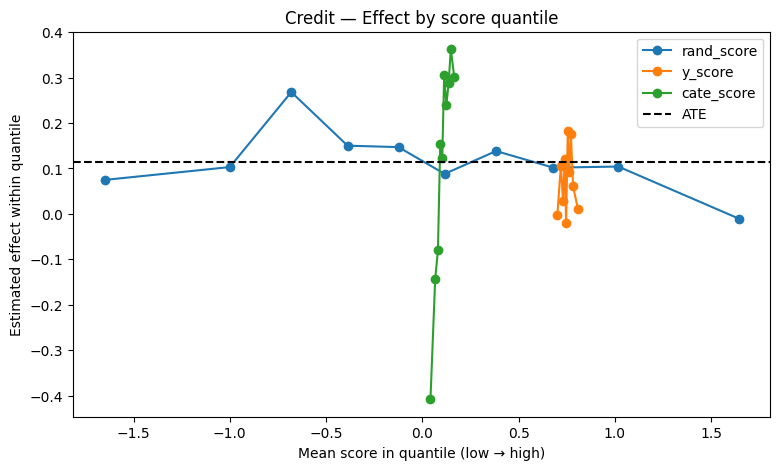
ATE: 0.11511809486628932
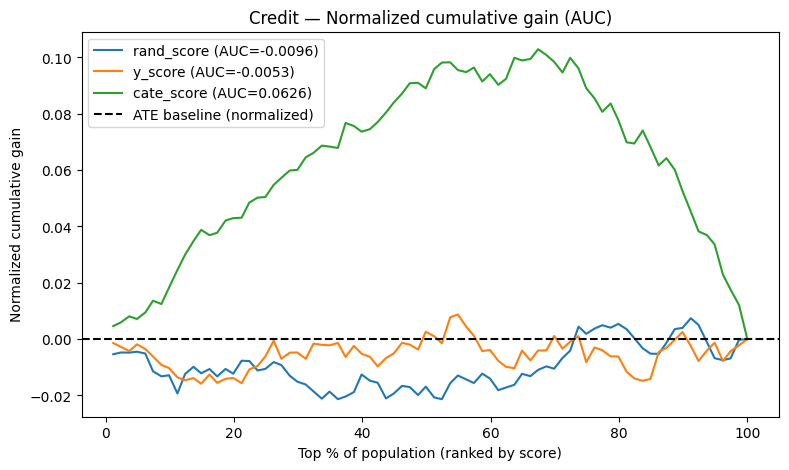
Final Comparative Visualization
Compares different scoring strategies in terms of treatment separation ability.
Best model is the one that best ranks customers by true treatment impact.
plot_effect_by_quantile(credit_scored, title="Credit — Effect by score quantile")
plot_cumulative_effect(credit_scored, title="Credit — Cumulative effect curve")
credit_aucs = plot_cumulative_gain(credit_scored, title="Credit — Normalized cumulative gain (AUC)")
credit_aucs
{'rand_score': np.float64(-0.009579854195870837),
 'y_score': np.float64(-0.005322435287123906),
 'cate_score': np.float64(0.06258574066502405)}
Proxy Diagnostics for Treatment Effect Signal
Uses proxy outcomes to approximate treatment effect alignment.
Since individual causal effect is unobserved, proxy diagnostics help evaluate signal quality.
def pseudo_outcome_wmse_report(df: pd.DataFrame):
    y = df["y"].values.astype(float)
    t = df["t"].values.astype(float)
    e = df["e_hat"].values.astype(float)

    tau_tilde = pseudo_outcome_transformed(y, t, e, clip=1e-3)
    e_clip = np.clip(e, 1e-3, 1 - 1e-3)
    w = e_clip * (1 - e_clip)

    scores = {
        "rand_score": df["rand_score"].values.astype(float),
        "y_score": df["y_score"].values.astype(float),
        "cate_score": df["cate_score"].values.astype(float),
    }
    return {k: weighted_mse(tau_tilde, v, w) for k, v in scores.items()}

print("Bank pseudo-outcome weighted MSE:", pseudo_outcome_wmse_report(bank_scored))
print("Credit pseudo-outcome weighted MSE:", pseudo_outcome_wmse_report(credit_scored))
Bank pseudo-outcome weighted MSE: {'rand_score': np.float64(4.944346175875895), 'y_score': np.float64(4.637766410428871), 'cate_score': np.float64(3.926534698283044)}
Credit pseudo-outcome weighted MSE: {'rand_score': np.float64(4.3827211075593295), 'y_score': np.float64(3.8825831197706777), 'cate_score': np.float64(3.4307246359223136)}
Chapter 6 Key Takeaways
Heterogeneous Treatment Effect modeling enables:
• Personalized decision making
• Efficient resource allocation
• Better causal policy design
Core conceptual takeaway:
Treatment impact is not constant across populations.
Estimating how treatment effect changes with features enables better decisions than using average effects.